FSSAI License for Imported Korean Food Products in India is one of the most important requirements for businesses planning to import, distribute, or sell Korean ramen, sauces, rice, Eomuk fish cake, Gochugaru, snacks, beverages, frozen foods, and other Korean food ingredients in the Indian market.
Korean food demand is growing in India because of K-dramas, K-pop, Korean cafés, ramen culture, and the popularity of spicy Korean-style food. But food import is a regulated business. Before selling imported food products in India, businesses must understand FSSAI licensing, food import clearance, labeling rules, shelf-life requirements, customs process, IEC, and product documentation.
This guide explains the complete process in a practical way for food importers, distributors, retailers, supermarkets, cafés, restaurants, and Korean food business owners.
Quick Answer
To import Korean food products into India, a business generally needs an FSSAI license, Importer Exporter Code, proper product documents, compliant labels, customs filing, food import clearance through FICS, and approval or NOC from FSSAI where applicable. FSSAI states that Food Business Operators in India are required to be licensed or registered, and imported food clearance is handled through its Food Import Clearance System integrated with Indian Customs.
Why FSSAI Compliance Matters for Korean Food Imports
Korean food products may look ready for retail sale, but Indian compliance must be checked before import. Products such as ramen, sauces, fish cake, rice, chilli powder, beverages, snacks, frozen foods, and ready-to-cook items may need food safety review, label correction, shelf-life check, document verification, and sampling.
Without correct Korean food import compliance, goods may face delay, testing, label objections, clearance issues, or rejection. This is especially important for temperature-sensitive products, non-vegetarian items, products with Korean-language labels, and products with special claims such as spicy, healthy, organic, vegan, or ready-to-eat.
BTN Insulo India Pvt. Ltd. supports businesses with Korean food products such as WANG ramen, rice, Eomuk fish cake, Gochugaru, and food ingredients for cafés, restaurants, retailers, and distributors. Explore BTN WANG Products.
FSSAI License vs Food Import Clearance
Many new importers confuse FSSAI license with food import clearance. Both are important, but they are not the same.
An FSSAI license allows a Food Business Operator to legally operate food-related business activities in India. Businesses can apply for food license or registration through the official FSSAI FoSCoS portal. FoSCoS is the official licensing and registration system for Food Business Operators.
Food import clearance is shipment-level clearance for imported food articles. FSSAI’s Food Import Clearance System, also called FICS, is an online single-window interface integrated with Indian Customs ICEGATE and SWIFT for imported food clearance.
So, if your business imports Korean food, you may need both: a valid food business license and shipment-wise import clearance.
Products That May Need FSSAI Import Planning
The following Korean food products should be checked carefully before import:
- Korean ramen and instant noodles
- Korean sauces and pastes
- Gochugaru red chilli powder
- Eomuk fish cake
- Kimchi and fermented food products
- Korean rice and grain products
- Snacks and confectionery
- Beverages and tea products
- Frozen or chilled food items
- Ready-to-cook and ready-to-eat foods
For example, FSSAI requirements for imported Korean ramen may involve ingredient review, additive check, vegetarian or non-vegetarian declaration, label compliance, shelf-life check, and import clearance documents.
Step-by-Step Process for FSSAI Food Import Compliance
1. Decide Your Business Model
First, identify whether you are an importer, distributor, retailer, café, restaurant, cloud kitchen, supermarket, or e-commerce seller. Your FSSAI category and compliance requirements may depend on your business activity.
2. Apply for the Correct FSSAI License
Use the official FoSCoS portal for FSSAI license or registration. The license category should match your business type, such as importer, distributor, storage, retail, food service, or other food business activity.
3. Get Importer Exporter Code
For commercial imports, businesses generally need IEC. DGFT states that Importer Exporter Code is mandatory for export or import from or to India, subject to policy provisions. Businesses can refer to the official DGFT portal for IEC-related processes.
4. Check Product Ingredients and Category
Before shipment, review the product’s ingredients, additives, claims, category, shelf life, vegetarian or non-vegetarian status, and packaging. This is important because some Korean products may contain seafood, meat extracts, alcohol-based ingredients, allergens, or additives that require careful declaration.
5. Prepare Import Documents
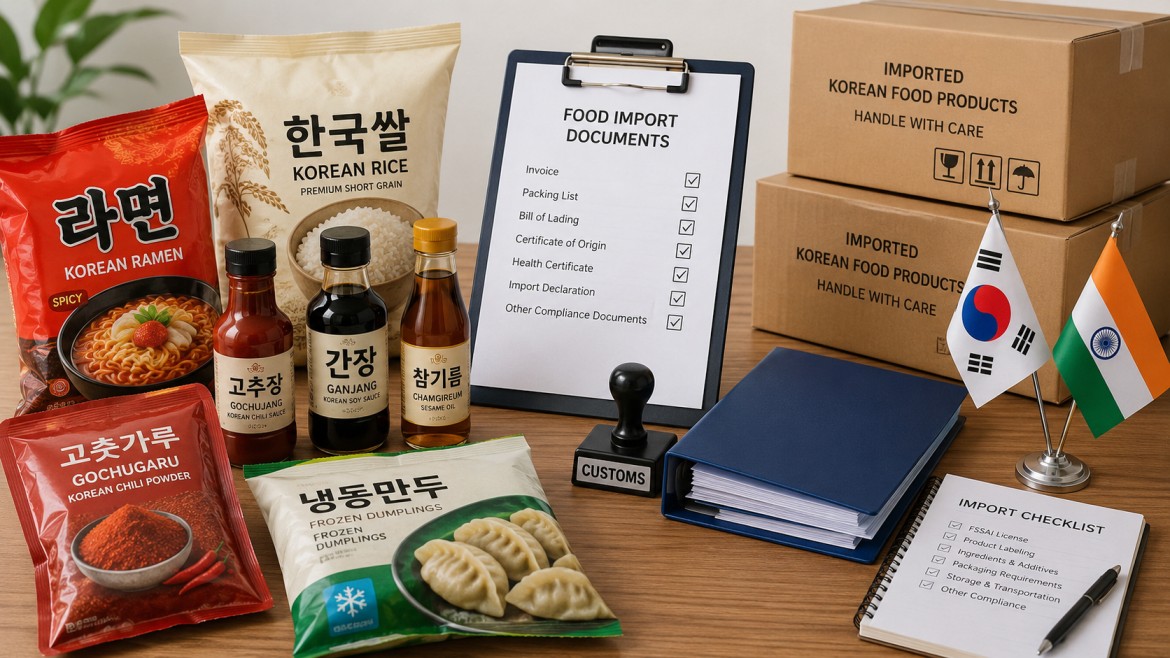
Documents required for importing Korean food to India may include commercial invoice, packing list, bill of lading or airway bill, certificate of origin, ingredient list, product specification, FSSAI license, IEC, label artwork, shelf-life declaration, test certificate, and manufacturer details.
6. File Customs and Food Import Clearance
The importer or customs broker files the Bill of Entry through Customs. FSSAI’s FICS is integrated with ICEGATE and SWIFT for food import clearance. Importers can also refer to the ICEGATE portal for customs-related processes and trade services.
7. Visual Inspection, Sampling and Testing
FSSAI’s import process may include document scrutiny, visual inspection, sampling, and testing based on product category and risk. A conforming sample may lead to NOC, while a non-conforming product may lead to a Non-Conforming Report.
Important Labeling Points for Imported Korean Food
Imported food labeling India is one of the most common reasons for clearance problems. Korean products often arrive with Korean-language labels, but Indian market products must meet Indian labeling requirements.
Check these points before shipment:
- Product name
- Ingredient list
- Allergen declaration
- Veg or non-veg logo
- FSSAI logo and license number
- Importer name and address
- Country of origin
- Net quantity
- Batch number
- Manufacturing date
- Best before or expiry date
- MRP in Indian currency
- Customer care details
- Storage instructions
FSSAI’s import FAQ states that imported food labeling requirements are covered under Food Safety and Standards packaging, labelling and import regulations. It also mentions that imported food should have not less than 60% shelf life at the time of import under the Food Import Regulations, 2017.
The Department of Consumer Affairs has also explained that pre-packaged commodities require declarations such as manufacturer, packer or importer details, country of origin, commodity name, net quantity, manufacturing details, MRP, and consumer care details.
Unique Checklist Before Ordering Korean Food Products
Before placing a bulk order, importers should complete this pre-shipment checklist:
| Checkpoint | Why It Matters |
|---|---|
| Product category | Helps decide FSSAI and import requirements |
| Ingredient list | Identifies allergens, additives, and non-veg content |
| Shelf life | Reduces risk of clearance or resale issues |
| Label artwork | Prevents rejection due to missing declarations |
| Storage condition | Important for frozen, chilled, or sensitive products |
| Supplier documents | Needed for import clearance and verification |
| MOQ and landed cost | Helps pricing and profitability |
| Indian market demand | Avoids slow-moving inventory |
This section is especially useful for importers working with Korean ramen, sauces, frozen Eomuk, kimchi, and ready-to-cook food products.
Common Mistakes to Avoid
Many businesses make mistakes because they import first and check compliance later. Avoid these problems:
- Importing without correct FSSAI license
- Not checking food category before shipment
- Ignoring shelf-life requirements
- Selling products with only Korean-language labels
- Missing importer details on packaging
- Incorrect veg or non-veg declaration
- Not checking allergens and additives
- No backup documents from manufacturer
- Wrong HS code or customs classification
- Not planning cold-chain storage
BTN provides Licensing & Certification Services for Indian regulatory requirements, including FSSAI, LMPC, BIS, EPR, CDSCO, import licensing, and product certifications.
How BTN Can Help
BTN Insulo India Pvt. Ltd. supports India–Korea trade, Korean food product supply, import-export documentation, supplier sourcing, licensing, and market-entry support. BTN’s import-export page mentions IEC support, customs documentation, HS code guidance, import duties, logistics, supplier coordination, and India–Korea trade expertise. View BTN Import & Export Solutions.
For FSSAI License for Imported Korean Food Products in India, BTN can support with:
- Korean food product sourcing
- WANG ramen, rice, Eomuk and Gochugaru supply
- FSSAI license guidance
- Food import clearance coordination
- Import-export documentation
- Labeling and compliance support
- Supplier communication
- Customs and logistics coordination
- India market entry assistance
Businesses can also explore BTN’s Product Sourcing & Outsourcing Services for supplier identification, procurement coordination, quality inspection, packaging checks, and sourcing support.
FAQs
1. Is FSSAI license required for importing Korean food products?
Yes, food importers generally need the correct FSSAI license or registration based on business activity. Imported food consignments also go through food import clearance under FSSAI’s import process.
2. Can I import Korean ramen into India?
Yes, Korean ramen can be imported into India, but the importer should check FSSAI license, ingredient details, label compliance, shelf life, IEC, HS code, customs documents, and food import clearance.
3. What is FICS in food import?
FICS means Food Import Clearance System. It is FSSAI’s online system for imported food clearance and is integrated with Indian Customs ICEGATE and SWIFT.
4. What happens if a food product fails testing?
If a sample is conforming, NOC may be generated. If it is non-conforming, a Non-Conforming Report may be generated, which can create clearance and business issues.
5. Can BTN help with Korean food import compliance?
Yes. BTN can support Korean food sourcing, FSSAI license guidance, food import clearance coordination, import-export documentation, labeling support, and complete India market entry assistance.
Conclusion
FSSAI License for Imported Korean Food Products in India is essential for importers, distributors, retailers, restaurants, cafés, and supermarkets planning to sell Korean food legally and safely in the Indian market. Korean food has strong potential in India, but importers must handle licensing, FICS clearance, IEC, labeling, shelf life, documents, storage, and customs coordination properly.
A well-planned import process protects the business from shipment delays, label objections, compliance risks, and product rejection. With the right supplier and regulatory guidance, imported Korean food products can become a strong business opportunity in India.