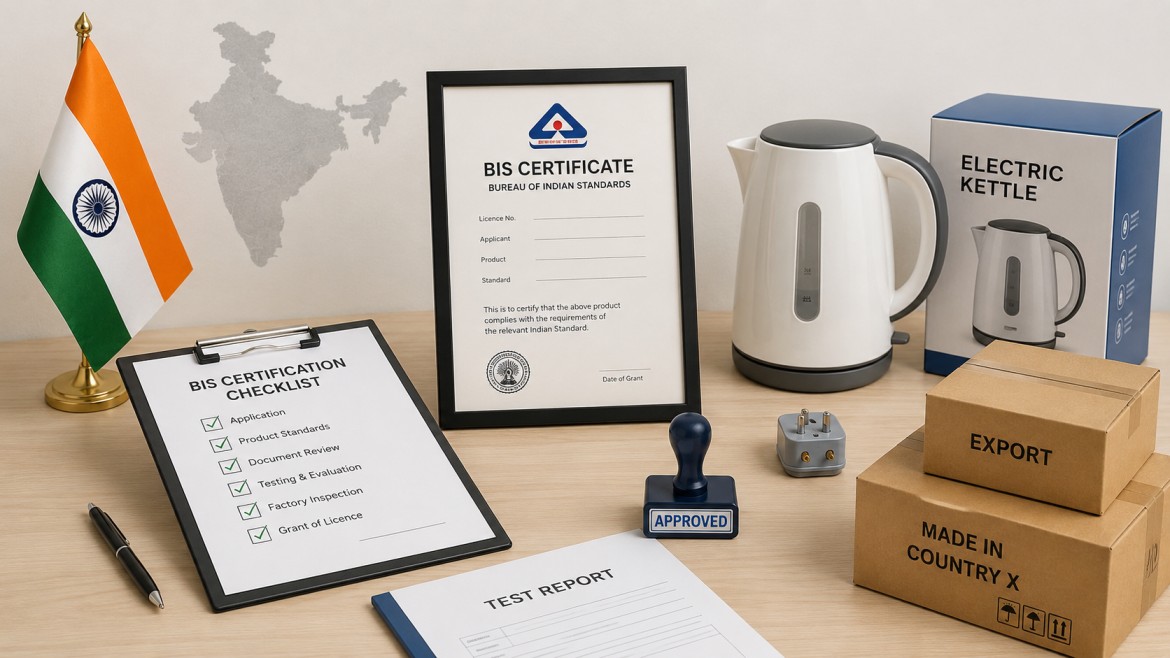
Foreign manufacturers planning to sell products in the Indian market must understand product compliance before shipping goods. India has strict quality and safety standards for many products, and in several categories, approval from the Bureau of Indian Standards becomes necessary before manufacturing, importing, selling, or distributing the product. This is where BIS Certification in India becomes important.
For global brands exporting electronics, electrical goods, industrial products, consumer items, machinery components, or other regulated goods, BIS approval can directly affect market entry timelines. A shipment may face delay, rejection, testing issues, or customs complications if the certification requirement is ignored.
This guide explains BIS Certification in India in a practical way for foreign manufacturers. You will understand the meaning, major schemes, process, documents, testing requirements, common mistakes, and how BTN Insulo India Pvt. Ltd. can support foreign companies with Indian Standards compliance and regulatory coordination.
What Is BIS Certification?
BIS certification is a conformity assessment process managed by the Bureau of Indian Standards, India’s national standards body. It confirms that a product meets the relevant Indian Standard for quality, safety, reliability, and performance.
According to BIS, product certification is generally voluntary, but for many products, compliance with Indian Standards has been made compulsory by the Central Government for reasons such as public interest, health, safety, environment, prevention of unfair trade practices, and national security. You can refer to the official BIS products under compulsory certification page for more details.
For foreign manufacturers, BIS Certification in India is not only a legal formality. It is a market access requirement. When a product falls under a mandatory certification order, the manufacturer must complete the applicable scheme before selling that product in India.
Why Foreign Manufacturers Need BIS Approval
Foreign manufacturers need BIS approval when their product is listed under compulsory certification or when Indian buyers, importers, government departments, or distributors demand certified products. It gives confidence to importers and customers that the product meets Indian quality expectations.
BIS approval can help with:
- Legal market entry in India
- Better trust among importers and distributors
- Smooth customs and compliance coordination
- Reduced risk of product rejection
- Stronger brand credibility
- Easier participation in institutional and B2B supply
For international brands, BIS Certification in India should be checked before production planning, labeling, shipment booking, or distributor agreements.
Main BIS Schemes for Foreign Manufacturers
Different products may fall under different BIS schemes. Selecting the correct route is the first step.
1. ISI Mark Certification
ISI Mark certification applies to many products where the manufacturer must show that the product conforms to a specific Indian Standard. This scheme may involve factory inspection, sample testing, documentation, approval, and permission to use the Standard Mark.
Products such as certain steel products, cement, electrical appliances, cables, pressure cookers, and other notified goods may fall under this kind of certification depending on the applicable order.
2. Foreign Manufacturers Certification Scheme
The Foreign Manufacturers Certification Scheme, also called FMCS certification, is specifically designed for manufacturers located outside India. BIS states that under FMCS, a licence is granted to a foreign manufacturer for use of the Standard Mark on a product that conforms to an Indian Standard. You can read more on the official BIS Foreign Manufacturers Certification Scheme page.
This scheme is important for foreign factories because approval is connected with the manufacturing location, product standard, factory capability, quality control system, and testing compliance.
3. BIS CRS Registration
BIS CRS registration, or Compulsory Registration Scheme, is commonly linked with electronics and IT goods. Products covered under CRS must be tested by BIS-recognised laboratories, and registration is required before they are manufactured, imported, sold, or distributed in India. The official BIS Scheme-II Registration Scheme page lists notified electronics and IT goods under this route.
For electronics exporters, the CRS route should be checked early because testing, model grouping, technical documents, brand details, and factory information must be aligned properly.
Step-by-Step BIS Certification Process
The exact process depends on the product and applicable scheme, but the usual flow includes the following steps.
Step 1: Product Identification and Standard Mapping
First, identify whether the product is covered under mandatory BIS certification. Then match the product with the correct Indian Standard. This stage is very important because the wrong standard may lead to wrong testing, incorrect application, and approval delay.
Step 2: Compliance Gap Review
Before filing the application, the manufacturer should review product design, raw material details, manufacturing process, testing facility, packaging, labeling, and quality control records. This helps identify gaps before official testing or inspection.
Step 3: Document Preparation
BIS documentation requirements may include company details, factory address, manufacturing process flow, product specifications, test reports, trademark details, authorization documents, quality control information, and nomination of an Indian representative where required.
Foreign manufacturers can also take support from BTN’s licensing and certification services in India for BIS CRS registration, ISI Mark certification, FMCS certification, product testing coordination, documentation preparation, and application support. BTN’s website also mentions support for regulatory advisory, import licensing, LMPC, FSSAI, EPR, and CDSCO-related compliance.
Step 4: Product Testing
Testing is one of the most important parts of product certification India. Depending on the scheme, samples may need to be tested in a BIS approved lab, BIS-recognised lab, or as per the official process. Any mismatch between product design and Indian Standard can cause failure or retesting.
Step 5: Application Filing
Once documents and test details are ready, the application is filed through the relevant BIS system. For many BIS-related services, businesses use the official MANAK Online BIS portal for application and certification-related processes.
Correct data entry, proper document format, and accurate product details are important because mistakes can delay approval.
Step 6: Factory Inspection, If Applicable
For FMCS certification and some other product certification routes, factory inspection may be required. Inspecting officers may review production capacity, testing facilities, quality systems, raw material control, sample records, and compliance with Indian Standards.
Step 7: Approval and Use of Mark
After successful review, testing, and approval, BIS grants the licence or registration. The manufacturer can then use the applicable mark or registration details as per BIS rules. The company must also follow post-approval compliance, surveillance, renewals, and marking requirements.
Key Documents Required
Document requirements vary by product, but foreign manufacturers should commonly prepare:
- Company registration certificate
- Factory address proof
- Manufacturing process flow chart
- Product technical specification
- List of machinery and equipment
- Quality control details
- Testing facility details
- Trademark or brand authorization
- Nomination details of Indian representative
- Product labels and packaging artwork
- Test reports, where applicable
- Authorization letter and undertaking
- Previous certification details, if any
For BIS Certification in India, all documents should be consistent. The company name, factory address, brand name, product model, and technical details must match across the application, test report, authorization, invoice, and labeling documents.
Common Mistakes to Avoid
Many foreign manufacturers face delays because of small but serious errors. Common mistakes include:
- Applying under the wrong BIS scheme
- Selecting the wrong Indian Standard
- Submitting incomplete technical documents
- Not checking model grouping rules
- Ignoring label and marking requirements
- Sending samples before confirming testing parameters
- Not appointing the right Indian representative
- Assuming one certificate covers all models
- Starting shipment before approval
- Missing renewal and surveillance requirements
Avoiding these mistakes can save time, cost, and shipment risk.
How BIS Certification Supports Import and Market Entry
BIS approval is closely connected with import planning. If a product is covered under a mandatory order, importers may need the certification details before customs clearance, sales, distribution, or listing on marketplaces. That is why importers and manufacturers should coordinate before production and shipment.
Businesses importing regulated goods can also benefit from professional import-export planning. BTN provides import-export solutions in India covering import-export documentation, customs clearance support, HS code guidance, logistics coordination, supplier coordination, and trade compliance support.
When certification and import planning work together, the market entry process becomes smoother.
Supplier and Product Planning for Foreign Brands
Before starting BIS Certification in India, foreign manufacturers should also check product demand, distributor requirements, packaging needs, pricing strategy, and import feasibility. A product may be technically strong but still face delays if compliance, documentation, labeling, or supply chain planning is weak.
BTN also supports companies through product sourcing and outsourcing services, including supplier identification, vendor sourcing, OEM and ODM sourcing support, quality inspection, procurement coordination, and packaging checks.
This is useful for companies planning long-term India operations, private-label supply, Korean product sourcing, industrial sourcing, or multi-product certification planning.
How BTN Insulo India Pvt. Ltd. Can Help
BTN Insulo India Pvt. Ltd. provides licensing and certification support for businesses entering the Indian market. For foreign manufacturers, BTN can help with:
- Product compliance assessment
- Applicable Indian Standard identification
- BIS scheme selection
- Documentation preparation
- Testing coordination
- Application filing support
- Indian representative coordination
- Import and customs compliance support
- Post-certification support and renewals
With India–Korea trade expertise and regulatory experience, BTN supports manufacturers, exporters, importers, and global brands that want smoother Indian market access.
Conclusion
For foreign manufacturers, BIS Certification in India is a key step for safe, legal, and trusted market entry. It helps products meet Indian Standards, supports importer confidence, and reduces the risk of compliance problems during sales or customs clearance.
Before exporting products to India, manufacturers should identify the correct standard, confirm whether certification is mandatory, prepare documents, plan testing, and understand the right scheme such as ISI Mark, FMCS, or CRS. A structured approach can reduce delays and improve approval chances.
BTN Insulo India Pvt. Ltd. helps global businesses simplify Indian regulatory compliance with practical support for certification, documentation, testing coordination, import-export planning, and market entry.
No. BIS certification is generally voluntary, but it becomes mandatory when a product is notified under a compulsory certification order. Manufacturers should check the product category before importing or selling in India.
Yes. Foreign manufacturers can apply through the applicable scheme, especially FMCS certification for products covered under the Standard Mark route. Electronics and IT goods may fall under BIS CRS registration depending on the product category.
ISI Mark certification usually involves product conformity with an Indian Standard and may include factory inspection. CRS is a registration route mainly used for notified electronics and IT products after testing through recognised labs.
The timeline depends on product type, scheme, testing availability, document readiness, inspection requirement, and authority review. Delays often happen when documents, samples, labels, or standards are not correctly prepared.
Yes. BTN supports Korean and other foreign manufacturers with product compliance assessment, documentation, testing coordination, application support, import compliance, and regulatory guidance for Indian market entry.