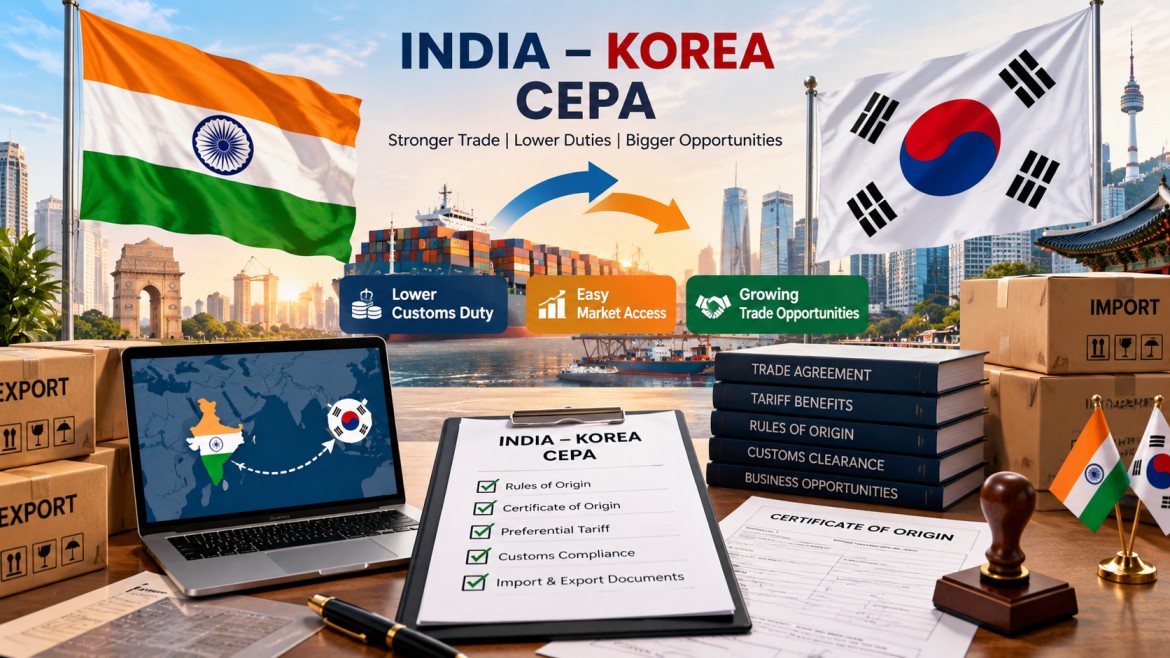
India–Korea CEPA is an important trade agreement for businesses involved in imports, exports, sourcing, manufacturing, distribution, and cross-border business between India and South Korea. For importers and exporters, this agreement can help reduce customs duty, improve market access, support trade in goods and services, and create smoother business opportunities between the two countries.
The Comprehensive Economic Partnership Agreement between India and the Republic of Korea was signed on 7 August 2009 and came into force on 1 January 2010. India’s Department of Commerce lists the agreement under its North East Asia trade relations information. Commerce Ministry
For Indian importers bringing Korean goods into India, and Korean exporters selling to Indian buyers, understanding India–Korea CEPA is important because the benefit is not automatic. Businesses must check product eligibility, HS code, rules of origin, certificate of origin, customs documentation, and import compliance before claiming any tariff preference.
BTN Insulo India Pvt. Ltd. supports India–Korea trade through import-export documentation, HS code guidance, customs clearance documentation, supplier coordination, logistics support, and FTA benefits consultation. BTN INSULO INDIA PVT LTD
Quick Answer
India–Korea CEPA is a bilateral economic partnership agreement between India and South Korea. It helps eligible importers and exporters claim preferential tariff treatment, provided the product qualifies under the agreement’s rules of origin and the correct certificate of origin is submitted during customs clearance.
What Is India–Korea CEPA?
CEPA stands for Comprehensive Economic Partnership Agreement. It is broader than a simple tariff agreement because it can cover trade in goods, trade in services, investment, rules of origin, customs procedures, and cooperation between the two countries.
For importers and exporters, the most practical benefit is preferential tariff treatment. This means that eligible goods may get lower customs duty compared to the normal duty rate, subject to the product schedule and compliance conditions.
The official India–Korea CEPA agreement document includes rules of origin and a certificate of origin format for preferential tariff treatment. Commerce Ministry
Why India–Korea CEPA Matters for Importers
Importers often focus on product price, freight, supplier payment, and customs duty. However, if the imported product qualifies under India–Korea CEPA, the landed cost may be reduced through preferential customs duty.
This can help importers in categories such as:
- Machinery and industrial components
- Electronics and electrical goods
- Food and FMCG products
- Packaging materials
- Chemicals and raw materials
- Consumer goods and retail products
- Café and restaurant equipment
- Korean food products and ingredients
BTN’s import-export services mention support across manufacturing goods, FMCG and food products, electronics and technology, chemicals, and consumer goods, making CEPA understanding useful for many business categories. BTN INSULO INDIA PVT LTD
Why India–Korea CEPA Matters for Exporters
For exporters, CEPA can help improve competitiveness in the buyer’s market. If an Indian exporter sells eligible products to South Korea, the Korean buyer may benefit from preferential tariff treatment when the required origin criteria and documents are satisfied.
Exporters should understand:
- Product HS code
- Applicable tariff preference
- Rules of origin
- Certificate of origin process
- Buyer documentation requirement
- Product-specific compliance
- Packaging and labeling requirements
DGFT’s Certificate of Origin platform is a common digital platform for certificates of origin for India’s FTAs and PTAs. It supports access to certificate of origin services for agencies and products. COO DGFT
Key Benefit: Preferential Tariff Treatment
The main business advantage of India–Korea CEPA is the possibility of preferential tariff treatment. However, this benefit depends on three important checks:
- Whether the product is covered under the agreement
- Whether the product satisfies rules of origin
- Whether a valid certificate of origin is submitted
Importers should not assume that every Korean product automatically gets lower duty. Product eligibility and origin qualification must be checked carefully before shipment.
For customs planning, importers can also use ICEGATE’s Compliance Information Portal, which provides commodity-wise information on customs procedures, regulatory agencies, and tariff-related compliance requirements. Press Information Bureau
Understanding Rules of Origin
Rules of origin are the heart of CEPA benefits. They decide whether a product can be treated as originating from India or South Korea under the agreement.
A product may qualify when it is:
- Wholly obtained or produced in the exporting country
- Sufficiently worked or processed as per CEPA conditions
- Supported by required production and origin documents
- Issued with a valid certificate of origin
For example, a product exported from South Korea to India may not qualify simply because it was shipped from Korea. It must meet the origin conditions under the agreement. The official agreement includes the certificate of origin format and origin-related conditions for preferential tariff treatment. Commerce Ministry
This is important for products made with imported raw materials, assembled goods, machinery, electronics, processed food, and private-label products.
Certificate of Origin Under India–Korea CEPA
The certificate of origin is a key document for claiming preferential duty. It proves that the product qualifies as originating under CEPA rules.
For exporters, the certificate of origin must be prepared carefully. For importers, the certificate should be checked before the shipment arrives, because customs may verify origin details during assessment.
A certificate of origin may include:
- Exporter details
- Producer details
- Importer details
- Product description
- HS code
- Origin criterion
- Invoice details
- Quantity and package details
- Certification by authorised body
DGFT has also introduced digital facilities for certificate of origin issuance and verification through Trade Connect, covering major trade agreements including India–Korea CEPA. Press Information Bureau
Documents Importers Should Prepare
For importing goods under India–Korea CEPA, businesses should prepare both normal import documents and CEPA-related documents.
Common documents include:
- Commercial invoice
- Packing list
- Bill of lading or airway bill
- Certificate of origin under CEPA
- Importer Exporter Code
- Product specification sheet
- HS code details
- Insurance certificate, if applicable
- Product license or certification, if required
- Bill of Entry
- Customs duty calculation sheet
- Supplier declaration, if needed
BTN provides import-export support including IEC registration, customs clearance documentation, HS code guidance, duties and tax structure guidance, shipment support, and supplier-to-buyer coordination. BTN INSULO INDIA PVT LTD
Documents Exporters Should Prepare
Exporters should prepare documentation according to buyer, product, and destination customs requirements.
Common export documents include:
- Commercial invoice
- Packing list
- Shipping bill
- Certificate of origin
- Product specification
- Test certificate, if applicable
- Export license, if required
- Insurance details
- Buyer purchase order
- Transport documents
- Compliance certificates, if applicable
Exporters should also confirm whether the buyer wants CEPA benefit. If yes, the certificate of origin and origin criteria must be aligned before shipment.
Step-by-Step Process to Claim CEPA Benefit
Step 1: Identify the Product HS Code
HS code classification decides duty, policy, and eligibility. Wrong classification can create duty errors and customs delays.
Step 2: Check Whether the Product Is Covered
Not every product gets the same benefit. Check the CEPA schedule and tariff treatment for the relevant HS code.
Step 3: Verify Rules of Origin
Confirm whether the product qualifies as originating under the agreement.
Step 4: Arrange Certificate of Origin
The exporter should arrange a valid certificate of origin under the agreement.
Step 5: Prepare Import Documents
Importers should prepare invoice, packing list, transport document, certificate of origin, customs declaration, and product compliance documents.
Step 6: File Customs Declaration
The importer or customs broker files the Bill of Entry and claims preferential tariff treatment.
Step 7: Keep Records
Businesses should maintain records for future verification, audit, or customs clarification.
Common Mistakes to Avoid
Many businesses lose CEPA benefits because of documentation mistakes. Avoid these errors:
- Assuming every Korean product gets lower duty
- Using the wrong HS code
- Not checking rules of origin
- Missing certificate of origin
- Incorrect product description
- Mismatch between invoice and certificate
- Late document submission
- Wrong origin criterion
- Not checking product-specific licenses
- Ignoring BIS, FSSAI, LMPC, EPR, or CDSCO requirements
BTN provides licensing and certification services for Indian market compliance, including BIS, FSSAI, LMPC, EPR, CDSCO, import licensing, product approvals, and documentation support. BTN INSULO INDIA PVT LTD
Current Update: CEPA Upgrade Discussions
India and South Korea have been working on CEPA upgrade discussions to modernise the agreement and improve trade cooperation. In 2026, India and Korea reaffirmed their commitment to conclude CEPA upgrade negotiations in a time-bound manner, covering areas such as trade in goods, services, rules of origin, investment, SPS standards, and cooperation. Press Information Bureau
Korea’s Ministry of Trade, Industry and Resources also announced the 13th round of upgrade negotiations in Seoul from 19 to 21 August 2026. Ministry of Trade
For businesses, this means importers and exporters should keep monitoring official updates because tariff schedules, market access, rules, services, and cooperation areas may change after the upgrade is finalised.
Practical CEPA Checklist for Businesses
| Checklist Point | Why It Matters |
|---|---|
| Product HS code | Decides tariff and eligibility |
| Product origin | Confirms whether CEPA benefit applies |
| Certificate of origin | Required for preferential tariff claim |
| Invoice match | Avoids customs mismatch |
| Product compliance | BIS, FSSAI, LMPC or other approvals may apply |
| Supplier verification | Reduces origin and document risk |
| Customs filing | Required for duty benefit claim |
| Record keeping | Useful for audit or verification |
How BTN Insulo India Pvt. Ltd. Can Help
BTN Insulo India Pvt. Ltd. is an India–Korea business and trade company founded to simplify business operations between India and South Korea. The company supports consulting, import-export, company setup, sourcing, regulatory guidance, and brand-building services. BTN INSULO INDIA PVT LTD
For India–Korea CEPA, BTN can support businesses with:
- HS code guidance
- Import-export documentation
- FTA and CEPA benefit consultation
- Certificate of origin document coordination
- Supplier and buyer coordination
- Customs clearance documentation
- Product compliance guidance
- India–Korea trade advisory
- Sourcing and market-entry support
Businesses can also explore BTN’s Import & Export Solutions, Licensing & Certifications Services, and Product Sourcing & Outsourcing Services for end-to-end trade support.
FAQs
1. What is India–Korea CEPA?
It is a Comprehensive Economic Partnership Agreement between India and South Korea. It supports trade and economic cooperation and may provide preferential tariff treatment for eligible goods.
2. Does CEPA reduce customs duty on all Korean imports?
No. Duty benefit depends on product coverage, HS code, rules of origin, tariff schedule, and certificate of origin.
3. What is the most important document for claiming CEPA benefit?
The certificate of origin is one of the most important documents because it supports the claim that the product qualifies under the agreement.
4. Can Indian exporters use CEPA for exports to Korea?
Yes, eligible Indian exporters can use CEPA if their product qualifies under the agreement and required documentation is completed.
5. Can BTN help with India–Korea CEPA documentation?
Yes. BTN can support with HS code guidance, import-export documentation, customs coordination, product compliance, sourcing, and India–Korea trade advisory.
Conclusion
India–Korea CEPA is a valuable agreement for importers and exporters, but the benefit depends on correct planning. Businesses must check HS code, product eligibility, rules of origin, certificate of origin, customs documents, and product-specific compliance before claiming preferential tariff treatment.
For companies importing from South Korea or exporting to Korea, CEPA can support better landed cost, stronger buyer confidence, and smoother bilateral trade when used correctly. With proper documentation and expert guidance, businesses can reduce risks and make better use of India–Korea trade opportunities.