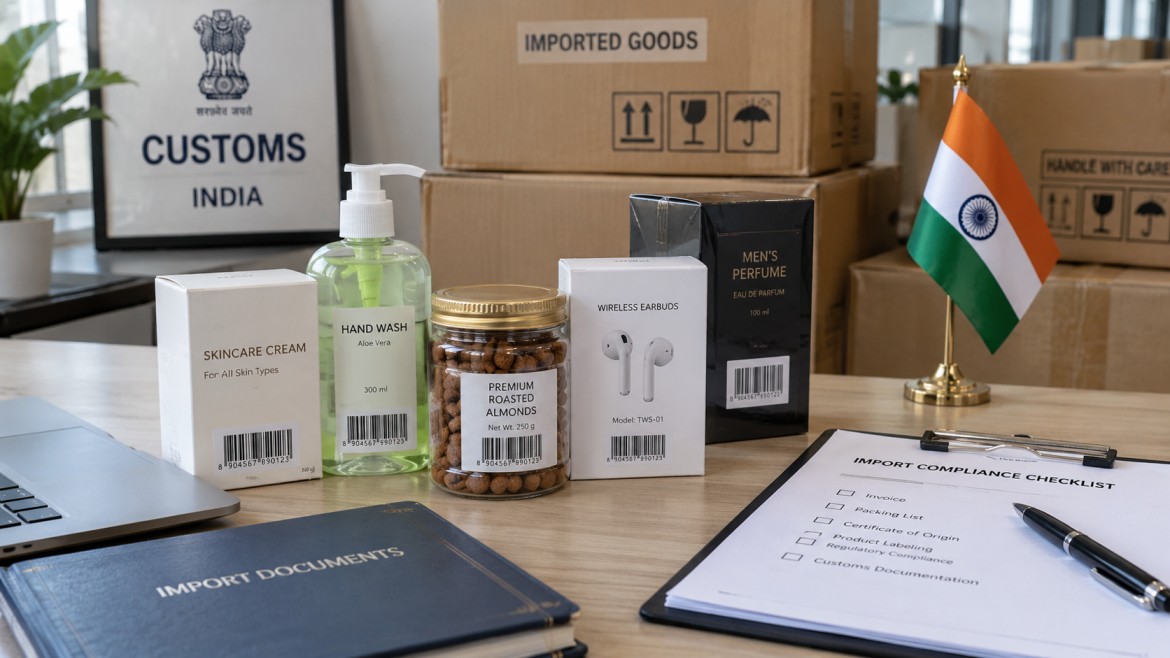
LMPC Registration for Imported Products is one of the most important compliance requirements for businesses importing pre-packaged goods into India. If your company imports packaged food, cosmetics, electronics, FMCG goods, machinery accessories, household items, Korean products, retail goods, or consumer products, you must check whether Legal Metrology registration and label declarations apply before selling or distributing the products in India.
Many importers focus only on customs duty, IEC, freight, and supplier pricing, but packaging compliance is equally important. A shipment may face delay, objection, relabeling issues, or market-sale problems if the imported package does not carry the required declarations. The Department of Consumer Affairs explains that a pre-packaged commodity is a commodity placed in a package without the purchaser being present, where the product has a pre-determined quantity.
This guide explains LMPC Registration for Imported Products in a simple and practical way for importers, distributors, retailers, e-commerce sellers, Korean product importers, and companies entering the Indian market.
What Is LMPC Registration?
LMPC stands for Legal Metrology Packaged Commodities. In business usage, LMPC registration generally refers to registration of manufacturer, packer, or importer under the Legal Metrology framework for packaged commodities.
The Legal Metrology portal mentions applications for registration of manufacturers, packers, and importers under Rule 27 of the Legal Metrology Packaged Commodities Rules, 2011.
In simple words, LMPC Registration for Imported Products helps ensure that packaged goods sold in India carry correct information such as importer details, product quantity, MRP, country of origin, manufacturing or import details, and consumer care information.
For importers, this registration is not only a paperwork formality. It is connected with consumer transparency, correct quantity declaration, fair trade practice, and legal sale of imported packaged goods in India.
Why LMPC Registration Matters for Importers
If you import goods in packaged form and plan to sell, distribute, deliver, or offer them in India, Legal Metrology compliance should be checked before shipment. The Department of Consumer Affairs lists mandatory declarations for packaged commodities, including the name and address of the manufacturer, packer or importer, country of origin for imported products, common or generic product name, net quantity, month and year of manufacture, MRP, consumer care details, and unit sale price.
LMPC Registration for Imported Products is useful because it helps importers:
- Sell packaged goods legally in India
- Avoid labeling-related objections
- Reduce customs and market compliance risk
- Build consumer trust
- Maintain correct MRP and quantity details
- Meet packaging compliance India requirements
- Support smooth retail and e-commerce listing
For businesses importing Korean food products, ramen, sauces, cosmetics, machinery parts, kitchen appliances, packaged containers, FMCG products, or retail goods, this compliance should be planned early.
Who Needs LMPC Registration?
Businesses that import pre-packaged commodities for sale, distribution, or delivery in India should check LMPC applicability. This may include:
- Importers of retail goods
- Korean product importers
- Food and FMCG importers
- Cosmetics importers
- Electronics and appliance importers
- Household product importers
- E-commerce sellers
- Supermarket suppliers
- Distributors and wholesalers
- Private-label import businesses
For example, if a company imports packaged Korean ramen, bottled sauces, packaged bowls, sealed cosmetics, consumer appliances, or household goods for retail sale in India, the importer should review LMPC Registration for Imported Products along with customs, IEC, FSSAI, BIS, or other product-specific approvals.
BTN Insulo India Pvt. Ltd. supports businesses with regulatory compliance, including import licensing, labeling and packaging compliance guidance, LMPC certificate support, FSSAI, BIS, EPR, CDSCO, and other certification requirements through its Licensing & Certifications Services.
LMPC Registration vs Other Import Compliance
Many importers confuse LMPC with other licenses. LMPC is mainly related to packaged commodity declarations and Legal Metrology compliance. It does not replace other product-specific approvals.
For example:
| Compliance | Main Purpose |
|---|---|
| IEC | Import-export business identification |
| LMPC | Packaged commodity registration and label declarations |
| FSSAI | Food safety license and food import clearance |
| BIS | Product quality and safety certification for notified products |
| EPR | Environmental responsibility for plastic, e-waste or battery categories |
| CDSCO | Cosmetics, medical devices, drugs and related regulated products |
IEC is also important because DGFT describes Importer Exporter Code as a key business identification number mandatory for import into or export from India.
So, LMPC Registration for Imported Products should be planned along with IEC, customs documentation, product certification, and labeling requirements.
Key Label Declarations for Imported Products
Imported product labeling is the most practical part of LMPC compliance. Before importing, businesses should check whether the product packaging can carry the required Indian declarations.
Common declarations may include:
- Name and address of importer
- Name and address of manufacturer or packer, where applicable
- Country of origin
- Common or generic name of the commodity
- Net quantity by weight, measure, or number
- Month and year of manufacture, packing, or import
- MRP inclusive of all taxes
- Consumer care name, address, phone or email
- Unit sale price, where applicable
- Product-specific declarations under other laws
The Consumer Affairs overview specifically mentions country of origin for imported products as part of mandatory declarations for packages.
A unique and important point is that imported packages should be reviewed before shipment, not after arrival. If the original foreign packaging does not contain Indian declarations, the importer may need to plan compliant labeling, stickers, or packaging updates according to applicable rules.
Step-by-Step LMPC Registration Process
Step 1: Check Whether the Product Is Pre-Packaged
The first step in LMPC Registration for Imported Products is checking whether the goods are pre-packaged commodities. If the package is sealed or packed before the buyer is present and carries a fixed quantity, Legal Metrology rules may apply.
Step 2: Identify Importer Details
The importer must have correct legal business details such as company name, registered address, GST details, IEC, contact details, and business activity information. Any mismatch between documents and labels can create compliance issues.
Step 3: Prepare Product and Label Information
Prepare a list of imported products, product categories, packaging sizes, net quantities, country of origin, MRP plan, manufacturer details, and consumer care information.
Step 4: Arrange Required Documents
Common documents may include:
- Company registration certificate
- Importer Exporter Code
- GST certificate
- PAN details
- Address proof
- Authorized signatory ID
- Product list
- Label or packaging artwork
- Importer address details
- Authorization letter, if applicable
- Trade license or business proof, if required
Document requirements may vary based on authority, state, product category, and application route.
Step 5: File Application
Applications for registration of manufacturers, packers, and importers under Rule 27 can be routed through the official Legal Metrology system, and official guidance also references the National Single Window System for such applications.
Step 6: Review, Clarification and Approval
After submission, the authority may review the documents and raise clarification if anything is missing or inconsistent. Once approved, the importer receives registration details or certificate as applicable.
Step 7: Maintain Ongoing Compliance
After approval, the importer must ensure that every applicable imported package carries correct declarations. If products, address, business details, or packaging changes, the importer should check whether amendment or update is required.
Unique Pre-Shipment Label Audit Checklist
Before importing, use this checklist to avoid delays:
| Checkpoint | Why It Matters |
|---|---|
| Product category | Confirms whether LMPC and other approvals apply |
| Package type | Checks whether it is a pre-packaged commodity |
| Importer details | Ensures Indian importer name/address is correct |
| Country of origin | Required for imported products |
| Net quantity | Must match actual package quantity |
| MRP | Should include all taxes where applicable |
| Month/year details | Helps meet declaration requirements |
| Consumer care details | Supports customer grievance handling |
| Other licenses | FSSAI, BIS, EPR or CDSCO may also apply |
| Label readability | Declarations should be clear and visible |
This checklist is especially useful for retail-ready imported products, Korean food items, consumer goods, cosmetics, appliances, and packaged accessories.
Common Mistakes Importers Should Avoid
Many businesses apply late or check packaging only after goods reach India. Avoid these mistakes:
- Importing retail packages without Indian label review
- Missing importer name and address
- Not declaring country of origin
- Wrong or missing net quantity
- MRP not mentioned correctly
- Label not matching invoice or product details
- Confusing LMPC with FSSAI or BIS
- Selling imported goods before compliance review
- Not updating registration after business changes
- Ignoring e-commerce marketplace label requirements
A planned LMPC Registration for Imported Products process helps reduce these risks.
How LMPC Connects with Customs and Import Planning
Legal Metrology compliance is connected with import planning because customs, marketplaces, distributors, and retailers may check packaging and declarations before allowing sale or distribution.
ICEGATE’s Compliance Information Portal provides commodity-wise information on customs procedures, compliance requirements, regulatory agencies, and customs tariff item-wise guidance for imports and exports.
BTN provides Import & Export Solutions including IEC registration support, import-export documentation, customs clearance documentation, HS code guidance, supplier coordination, shipment support, and trade compliance for businesses entering India.
If you are importing from South Korea or any other country, your landed cost planning should include product cost, freight, duty, GST, labeling cost, warehouse cost, compliance cost, and distribution margin.
How BTN Insulo India Pvt. Ltd. Can Help
BTN Insulo India Pvt. Ltd. helps businesses manage India market entry, licensing, import-export compliance, supplier coordination, and documentation. BTN’s company profile highlights its India–Korea business consulting and trade focus, with support for sourcing, import-export, product development, and regulatory strength.
For LMPC Registration for Imported Products, BTN can support with:
- Applicability assessment
- Product and packaging review
- Label declaration guidance
- Document preparation
- Import licensing support
- IEC and customs coordination
- LMPC certificate support
- FSSAI, BIS, EPR and related compliance guidance
- Korean product import support
- India market entry assistance
Businesses importing Korean food products, consumer goods, machines, appliances, packaged bowls, cosmetics, FMCG products, or retail goods can connect with BTN for structured compliance support.
FAQs
1. What is LMPC Registration for Imported Products?
It is registration and compliance support under the Legal Metrology framework for importers dealing in packaged commodities meant for sale, distribution, or delivery in India.
2. Is LMPC registration required for all imported products?
Not all imports are treated the same. It mainly applies when goods are imported as pre-packaged commodities for sale or distribution. Product type, packaging, quantity, and end use should be checked before import.
3. What details are required on imported packaged goods?
Common details include importer name and address, country of origin, product name, net quantity, MRP, month and year details, and consumer care information, along with any product-specific declarations.
4. Is IEC required along with LMPC?
Yes, for commercial import activities, IEC is generally required. LMPC and IEC serve different purposes, so importers may need both depending on the business activity.
5. Can BTN help with LMPC and import compliance?
Yes. BTN Insulo India Pvt. Ltd. supports LMPC certificate guidance, labeling review, import-export documentation, licensing, customs coordination, and India market entry support.
Conclusion
LMPC Registration for Imported Products is an important compliance step for importers selling pre-packaged goods in India. It helps ensure that consumers receive correct information about the product, importer, quantity, price, origin, and customer support details.
For a smooth import business, do not treat LMPC as a last-minute step. Check packaging, labels, importer details, product category, and other licenses before shipment. This reduces the risk of customs delays, relabeling problems, retail rejection, and marketplace listing issues.
A structured approach with proper documentation and expert support can make the import process smoother and more reliable.