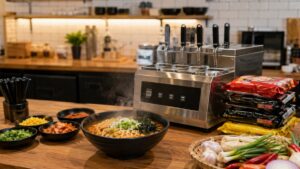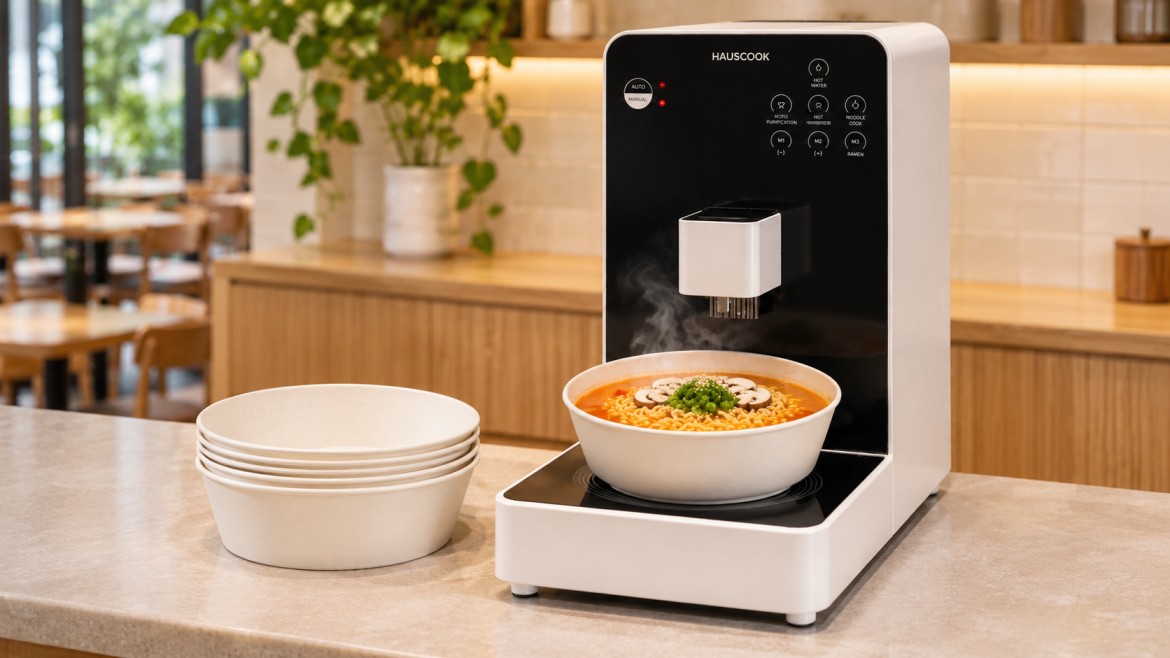
Buying a HAUSCOOK Ramen Machine starts with three practical checks: your electricity supply, your water connection and your cooking containers. Get these right, and you can plan a smoother ramen service. Overlook them, and a compact counter can become difficult to operate.
This guide helps Indian café owners, kiosk operators and restaurant teams compare equipment before ordering. It draws on published product information, while separating listed features from details that require confirmation for your specific unit.
What does a HAUSCOOK Ramen Machine do?
HAUSCOOK combines induction cooking with hot-water dispensing, with filtration available depending on configuration. Instead of managing separate steps manually, operators can use the controls to prepare suitable meals with repeatable settings.
The manufacturer’s official cooker overview describes induction heating, hot-water supply and water purification. However, buyers should confirm which functions and accessories are included in their quotation.
An induction ramen cooker can suit cafés, convenience stores, office pantries and food counters. Nevertheless, suitability depends on your menu, service volume and available utilities.
Start with BTN’s HAUSCOOK product listing to understand the advertised features before requesting model-specific documentation.
Check power before buying a HAUSCOOK Ramen Machine
First, request a clear photograph of the rating plate. Ask for the exact model number, rated voltage, frequency and maximum electrical input. Similar-looking machines can have different specifications for different markets.
For ramen machine power requirements, avoid copying figures from another brand or an overseas listing. Your electrician should assess the supplied unit, socket, earthing and available circuit capacity together.
Ask these questions before installation:
- Does the unit match the site’s voltage and frequency?
- What socket and protective devices does the manufacturer specify?
- Can the circuit support nearby equipment operating simultaneously?
- Where will the cable run, away from water and customer movement?
Additionally, distinguish rated power from measured electricity use. A rating describes electrical input under specified conditions; it does not establish your daily bill. Ask for consumption measurements covering cooking, warm-up and standby.
For example, a counter serving lunch and evening customers may spend considerable time between orders. Therefore, test the intended operating schedule rather than estimating costs from cooking time alone.
Plan the water supply around your counter
Before ordering a HAUSCOOK Ramen Machine, establish how water will reach it. Ask whether the quoted configuration requires a direct connection or supports an approved external pump arrangement. Do not assume both options come as standard.
Your ramen machine water supply plan should cover inlet requirements, hose routing, access for maintenance and the procedure when water runs low. For a permanent café, discuss plumbing with the installer. For a temporary kiosk, confirm the complete approved arrangement before committing.
Also, ask whether filtration is included or optional. A filter’s presence alone does not establish that every incoming water source is suitable. Obtain the specified inlet-water conditions and replacement schedule.
Keep a written cleaning routine for accessible water-contact components. Similarly, record filter changes and inspect connections for leakage according to the manual.
BTN’s machine and container overview lists optional purification and counter dimensions. Use those details for initial planning, then confirm the delivered configuration.
Match bowls to your HAUSCOOK Ramen Machine
Ordinary takeaway bowls should never be assumed suitable for induction cooking. Container construction, base dimensions and the machine’s detection system all matter. Consequently, approval should cover the exact bowl and cooker combination.
The manufacturer’s induction heating guide explains how electromagnetic induction generates heat in suitable cookware. This makes compatibility a functional requirement, rather than a packaging preference.
BTN lists 1450 ml induction paper bowls with a 19 cm upper diameter, 17 cm base diameter, 6.5 cm height and packing of 300 containers. Confirm current specifications and compatibility before ordering.
Importantly, nominal capacity is not a recommended cooking fill level. Leave the headroom specified for boiling, noodles and toppings. Ask the supplier to demonstrate the intended recipe without overflow.
For ramen machine bowl compatibility, check detection, heating performance, leakage and handling after cooking. Treat disposable containers as single-use products, following the supplier’s instructions.
Test recipes and realistic serving speed
A HAUSCOOK Ramen Machine demonstration should use the noodles, water quantity and toppings you intend to sell. Marketing cooking times cannot predict every recipe or operating condition.
As a practical test, prepare several consecutive bowls. Record loading time, cooking time, handover time and any wait for the next cycle. Then assess whether the result meets your lunch-hour demand.
A commercial noodle cooking machine still needs a sensible workflow. Keep ingredients within reach, provide a safe landing area for hot bowls and separate customer movement from replenishment tasks.
For a self-service ramen station, display simple operating instructions and provide staff assistance. Customers must know how to position containers and handle hot food safely.
If you are still choosing the business format, read BTN’s Korean ramen café setup guide alongside your equipment planning.
Compare the complete cost of ownership
When comparing a HAUSCOOK Ramen Machine quotation, include the accessories and consumables needed to operate it. A lower initial figure may exclude installation items, compatible containers or replacement filters.
Request written details covering:
- Supplied model, accessories and installation responsibilities.
- Bowl availability, minimum order quantities and delivery lead times.
- Filter and spare-part availability.
- Training arrangements and troubleshooting support.
- Warranty coverage, exclusions and service procedures.
For broader procurement needs, BTN’s product sourcing services describe support with supplier identification and procurement coordination. Confirm the scope applicable to your purchase.
Before you buy HAUSCOOK Ramen Machine in India, calculate a realistic cost per serving. Include noodles, toppings, bowls, utilities, labour and wastage. Avoid relying on equipment claims as proof of profitability.
Measure the space and plan maintenance access
A compact appliance still needs working space around it. Measure the counter before placing an order, including the area required for hoses, filters and access to controls. Follow the clearance requirements in the supplied installation instructions.
Next, sketch where noodle packets, toppings, fresh containers and finished bowls will sit. Check whether staff can replenish supplies without reaching over a hot cooking area. Also, ensure cleaning can happen without moving other appliances every day.
For shared premises, confirm that the landlord or facilities team accepts the proposed utility arrangement. This is especially useful in malls, office buildings and temporary event spaces, where installation access may be restricted.
Turn a demonstration into a purchase checklist
Bring a short checklist to the demonstration and ask the supplier to record the results. Include the model shown, the container used, the recipe settings and the accessories fitted. These details make the demonstration easier to compare with the quotation.
Afterwards, ask who will provide support if a fault occurs. Establish the reporting process, what information the service team needs and whether parts or transport attract additional charges. Written answers reduce uncertainty when the counter is already operating.
Finally, nominate a staff member to manage operating instructions, cleaning records and consumable reorders. Set a reorder point based on actual bowl usage and delivery time. Keeping compatible containers available is as important as choosing the machine itself.
Editorial note: This buying guide is based on published manufacturer and BTN product information, not independent laboratory testing. Specifications, accessories and service terms should be verified against the current quotation and supplied manual. Recipe demonstrations should establish suitability for your own menu before you commit to a full rollout.
Frequently asked questions
What are the HAUSCOOK Ramen Machine power requirements?
Use the rating plate and manual for the exact supplied model. Ask a qualified electrician to confirm the installation requirements before connecting the appliance.
What are the HAUSCOOK Ramen Machine water supply options?
Ask which connection arrangement the quoted unit supports and which components are included. Obtain written confirmation before planning plumbing or a portable setup.
Which bowls are compatible with HAUSCOOK Ramen Machine?
Choose supplier-approved induction containers for the specific model. BTN advertises 1450 ml containers, but capacity alone does not prove suitability for every cooker.
Choose a HAUSCOOK Ramen Machine with confidence
The right HAUSCOOK Ramen Machine should fit your electrical supply, water arrangement, approved bowls and expected service demand. Before paying, request documentation and a recipe demonstration. Keep the agreed specifications with your purchase records.
For equipment and container enquiries, contact BTN Insulo India Pvt. Ltd.. Share your city, counter layout, utility arrangements and planned daily servings so the team can discuss a suitable configuration.
Product enquiries: +91 93126 44992
Email: btn@btnindia.com